On a hill overlooking the sea on Naoshima in the Seto Inland Sea stands a building by Tadao Ando that is both a museum and a hotel. Only overnight guests may walk its galleries after closing, until 11 pm. Inside architecture half sunk into the hill, you meet the artworks in the quiet after the day’s visitors have gone.
A museum half sunk into a hill
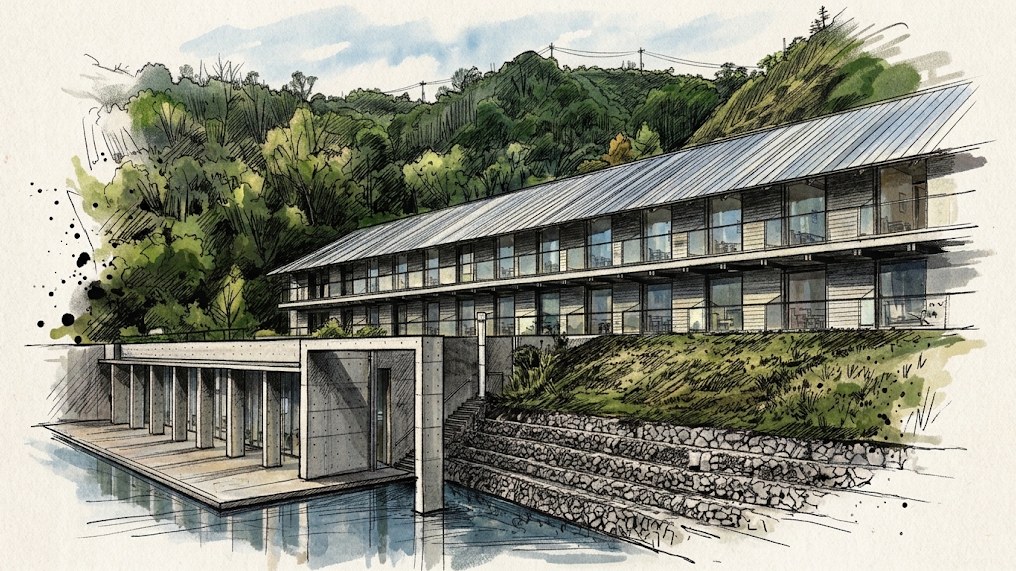
On a hill on Naoshima overlooking the Seto Inland Sea stands Benesse House Museum. It was designed by Tadao Ando and opened in 1992. Under the concept of “coexistence of nature, architecture and art”, it combines a museum and a hotel in one.
Even looking up at the hill from the sea, it is hard to tell how big the building is. Ando set out to protect the landscape of the Inland Sea by burying half of the building in the ground. The total floor area is about 3,600㎡, yet it barely rises above the line of the hill. In the island’s scenery, the building holds itself back.
A schematic based on the official Japanese description, “burying half of the building in the ground”. The actual shape and proportions differ.
The question of this story lies in that decision to bury. Sinking a museum into a hill makes the building you see from outside smaller. In exchange, it creates spaces within that choose which outside light and views to take in.
To bury is not to hide. It is also to choose what to show.
Benesse House later added more buildings for guests. Oval opened in 1995, Park and Beach in 2006, and today there are 65 rooms in four buildings. All were designed by Ando. Over more than a decade, one architect layered building upon building on one corner of the island.
Four buildings, two materials
The Museum is built of reinforced concrete, constructed by Kajima Corporation from 1990 to 1992. Galleries and ten guest rooms share the same building. With rooms inside the museum, you sleep under the same roof as the artworks.
Oval stands on top of the hill, reached from the Museum by monorail. It is the highest of the four buildings and has just six rooms. It is known for its oval pool of water and its open void. The journey itself, riding a small car up the hill, puts distance between you and the outside world.
Park and Beach, which opened in 2006, are two-storey timber buildings. Park is officially introduced as “one of the few wooden facilities in Ando’s architecture”. The architect known for concrete chose wood for the gentle land by the sea. Beach has suites only and is the closest of the four to the sea.
A concrete museum on the hill, and timber lodgings by the shore. The same architect changed his materials to suit the different terrain. Choosing which building to stay in is also choosing which terrain and which material to sleep within. Each of the 65 rooms displays a different work of art.
Note that children aged five and under cannot stay in the Museum or Oval.
Walking a museum after closing
The Museum is open to the public from 8 am to 9 pm. Hotel guests can view the Museum and the “Hiroshi Sugimoto Gallery: Time Corridors” in Park until 11 pm. For two hours after the visitors leave, the galleries belong to the guests alone.
On the basement floor hangs Hiroshi Sugimoto’s photographic series “Time Exposed”, and seascapes from the same series are also placed outdoors. Bruce Nauman’s “100 Live and Die” is on the basement floor too. Only guests can compare the same works by day, among the crowds, and by night, in the quiet.
For guests, a gallery tour is held every day from 4 pm. At Park, an art tour starts at 5:20 pm, with another at 8 pm on Fridays and Saturdays. Either way, you can learn the background of the works and then return to the galleries at night.
If you stay, stand in front of the outdoor Sugimoto works toward evening, and lay the horizon in the photograph over the horizon of the Inland Sea before you. After sunset, in the half-buried galleries, watch how the outside light fades away. What it means to bury a building should be clearest at night.
Ando’s architecture, layered on an island
After Benesse House, Ando’s buildings kept multiplying on Naoshima. The Chichu Art Museum opened in 2004, the Lee Ufan Museum in 2010, and in 2013 the ANDO MUSEUM, a renovated old house. In May 2025 the Naoshima New Museum of Art opened, said to be the tenth Ando building on the island.
- 1992Benesse House Museum
- 1995Benesse House Oval
- 2004Chichu Art Museum
- 2006Benesse House Park and Beach
- 2010Lee Ufan Museum
- 2013ANDO MUSEUM
- 2025Naoshima New Museum of ArtSaid to be the tenth Ando building on the island
Ando has said that a museum where the sensibility of an individual client shines this brightly is rare. His work on Naoshima began with Benesse House. The Chichu Art Museum, as its name (“in the earth”) suggests, is a museum set underground, and can be read as taking Benesse House’s idea of burying further. Tour the island the day after your stay, and you can trace 33 years of change in one architect.
Three things to see here
- 1The Museum galleries after closingFrom closing at 9 pm until 11 pm, only guests may walk here. Compare the works by Sugimoto and Nauman on the basement floor by day and by night.
- 2The monorail from the Museum to OvalA small car climbing to the highest hill of the four buildings. On the way, see how the Museum sinks into the hill.
- 3Hiroshi Sugimoto’s “Time Exposed”, outdoorsThe horizon of a photographed seascape and the horizon of the Inland Sea in front of you. Lay one over the other at dusk.
Related column Reinforced concreteA division of labour between push and pull: reinforced and exposed concrete Related column Timber constructionJoining wood, building in wood: Japanese timber today「A museum where the sensibility of an individual client shines as it does on Naoshima is, I think, rare.」
Tadao Ando (Benesse Art Site Naoshima official magazine, January 2024; translated by SUMIBIKI)